

Passionfruit Chocolate Macarons
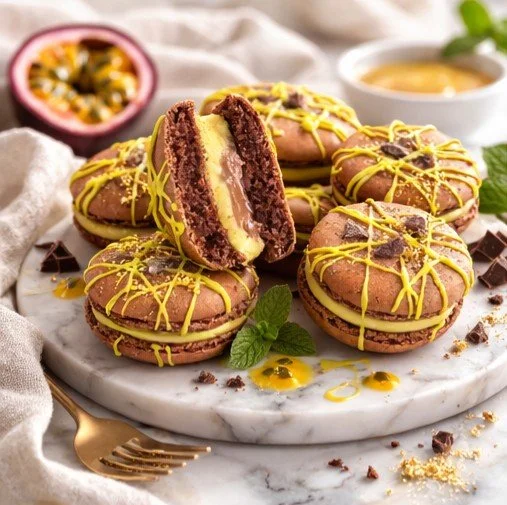
The combination of tart passionfruit and rich chocolate is a total dream, and these Chocolate Passionfruit Macarons are about to become your new obsession! Imagine biting into a perfectly chewy cocoa shell to find a luscious, silky dual-filling. It is a serious show-stopper. Whether you’re prepping for a special celebration or just want to treat yourself to a little kitchen magic, this recipe is guaranteed to impress.
Mastering the perfect macaron might seem tricky, but I’m sharing all my best tips, including my favorite 'aging' trick, to ensure you get those beautiful, perfect feet every single time. Trust me, these are just as magical to make as they are to eat! Grab your mixing bowls and let's dive into this baking adventure!
Secrets Of My Passionfruit Chocolate Macarons Recipe:
The Ultimate Flavor Duo: The bright, zingy tartness of the passionfruit ganache perfectly cuts through the richness of the milk chocolate and cocoa shells. It’s a match made in dessert heaven!
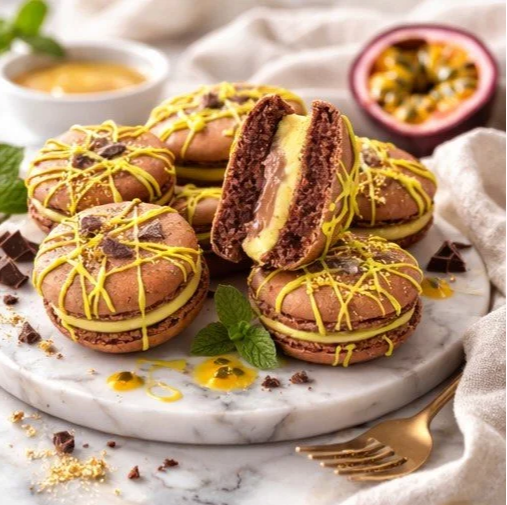
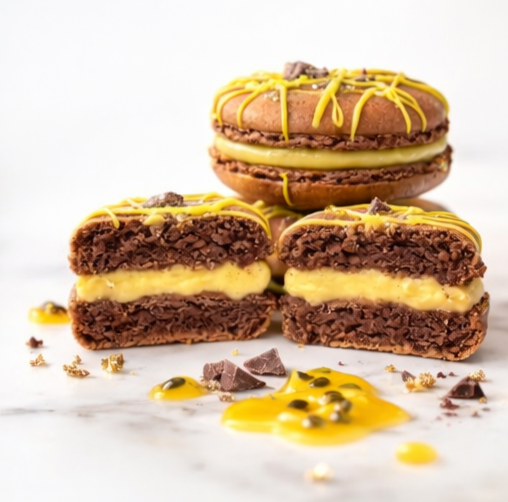
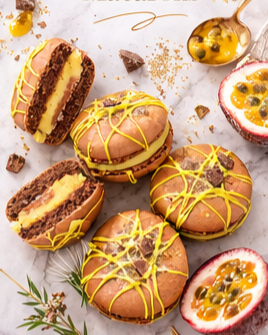
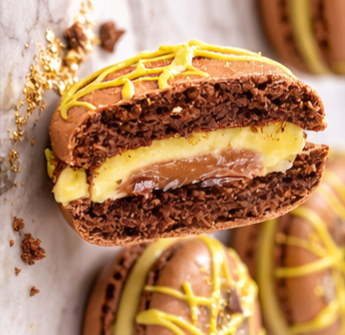
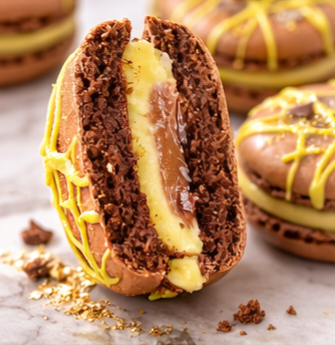
Dual-Filling Magic: We aren’t just doing one filling here; we’re creating a beautiful "ring" of passionfruit with a hidden chocolate-orange center. Every bite is a delicious surprise!
Foolproof Techniques: I’m sharing my tried-and-true "aging" method, heated sugar, and the double-pan baking tricks. These small steps make a huge difference in getting those tall, dainty macaron feet we all crave.
Secrets for the Best Passionfruit Chocolate Macarons
The Power of Aging: Don’t skip the overnight aging of your egg whites! Leaving your covered egg whites on the counter overnight is one of the best tricks for achieving those perfectly whipped, stiff peaks that are so essential to a successful shell.
Mastering the Macaronage: The goal is to remove the air bubbles without overmixing. You’ll know your batter is ready when it flows from your spatula like a thick ribbon and can "draw" a number 8 without breaking. If it’s runny, it’s over-mixed so watch it closely!
The 24-Hour Maturation: This is the ultimate secret to texture! Refrigerating your filled macarons for at least 24 hours allows the shells to "absorb" the filling. This develops the flavor and creates that signature melt-in-your-mouth experience.
Essential Prep for Passionfruit Chocolate Macarons Recipe
The Overnight "Age": This is my #1 secret! Separate your egg whites from the yolks the night before, cover them, and leave them on the counter overnight. This "ages" the whites, which is the absolute best trick for getting those perfectly whipped stiff peaks that are so essential for a stable macaron shell.
The Grease-Free Wipe: For a perfect meringue, your stand mixer bowl and whisk must be 100% grease-free, clean, and dry! I always recommend wiping them down with a paper towel soaked in a little vinegar or lemon juice just to be safe. Even a tiny bit of residue can keep your whites from fluffing up.
The Sift is Key: Always, always sift your powdered sugar, almond flour, and cocoa powder into a separate clean bowl. This ensures those iconic, smooth-as-silk tops! If you find any large pieces that won't pass through the mesh (usually no more than a teaspoon), just discard them.
Yield: Approximately 24 to 30 filled macarons (depending on how large you pipe your 1-inch discs).
Ingredients for Chocolate Passionfruit Macarons
125 g egg whites, room temperature
125 g granulated sugar
6 g egg white powder
128 g powdered sugar
128 g almond flour (not almond meal)
8 g unsweetened cocoa powder
Brown food coloring gel
How to Make Chocolate Passionfruit Macarons
To be done the night before: Separate your egg whites from egg yolks and leave the covered egg whites on the counter overnight to “age.” This is one of the best tricks leading to perfectly whipped stiff peaks that are essential to the success of baked macaron shells.
Preheat your oven to the standard bake setting at 350°F. Add granulated sugar and egg white powder into a heat-proof container or measuring cup; whisk until combined. Line a baking pan with a sheet of parchment paper and drizzle the sugar mixture over it, spreading evenly. Make sure it’s not too thin—lift the edges of the parchment paper on all sides to even out the sugar mixture edges. Bake on the middle rack for 5 minutes.
Add the egg whites into a grease-free, clean, dry stand mixer bowl (wipe with a vinegar or lemon juice-soaked paper towel ahead of time). Mix on the lowest speed until egg whites start forming bubbles, gradually increasing the speed to medium-low. Once your egg whites start foaming up, increase the speed to medium and mix until they become frothy, forming soft peaks. By this time, your sugar and egg white powder has warmed up in the oven. Remove it from the oven and transfer it back to your weighing cup or bowl (the easiest way is to lift the parchment paper from opposite ends to form a funnel). Reduce the mixer's speed to the lowest setting and add 1 teaspoon of the warm sugar mixture at a time, pouring it right between the whisk and the bowl while the mixer is continuously whisking. Be careful not to throw the sugar mixture onto the whisk! Once all sugar is added, add a few drops of brown food coloring gel and increase the mixing speed to medium for approximately 3 minutes. Finally, increase the mixer’s speed to the highest setting and whip for 3-5 minutes until stiff peaks are achieved.
While your meringue is getting to stiff peaks, sift together the powdered sugar, almond flour, and cocoa powder into a separate clean, dry bowl. Discard any large pieces that do not freely pass through the mesh sifter (this should not be more than 1 tsp).
Once your meringue is ready, remove the bowl from the stand mixer and add the dry ingredients all at once. Fold the dry ingredients into the meringue with a silicone spatula. Once no dry ingredients are visible, start the macaronage: the goal is to remove the air bubbles from the macaron batter without overmixing by pressing and turning the batter against the side of your bowl. Every 3 turns, check for readiness: your batter is ready when it flows slowly from your spatula like a thick ribbon and fully flattens within 30 seconds. Another test is "drawing" a number 8 with the batter; it should flow without breaking. The batter should not be runny—if it is, you have over-mixed.
Prepare a piping bag fitted with a number 10 or 11 (0.5 cm) piping tip and transfer the batter into the bag. Pipe the batter onto a silicone macaron mat placed onto your second oven tray. (I do not recommend using parchment paper as it does not hold the shape as well or provide flat, unbroken bottoms; however, if you do not have mats yet, parchment paper is okay). Holding your piping bag perpendicular to the mat, slowly pipe a one-inch diameter disc, releasing with a “wiping” motion. Tap your baking tray on the counter a few times; use a toothpick or scriber to pop any air bubbles on the surface. Rest the shells for 30 to 40 minutes until the batter forms a skin, doesn't stick to your finger, and loses some of its shine.
Meanwhile, preheat your oven to 320°F (any oven needs 10 to 20 minutes to reach the right temperature) along with an additional baking sheet on the middle rack. Baking on doubled baking sheets prevents uneven or lopsided macarons! Place the baking pan with the silicone mat onto the preheated separate baking sheet on the middle rack. Bake for 20-25 minutes, turning the tray around halfway through after the first 15 minutes. Macarons are fully baked when they do not feel wiggly or flimsy if lightly touched. Allow them to fully cool before removing them from the mats.
Pro-tip: If your oven is quite hot/strong and your macarons typically “brown” during baking, place a piece of domed aluminum foil over them after 10-15 minutes of baking. You may also try this setting: preheat to 350°F, place the piped shells inside and immediately reduce the heat to 300°F. Bake for 25-27 minutes, covering with foil halfway through.
Ingredients for Passionfruit Ganache
60 g fresh or frozen seedless passionfruit puree
55 g heavy cream
10 g unsalted butter
125 g high quality white chocolate, chopped
How to Make Passionfruit Ganache
Bring the passionfruit puree to a boil. Separately heat the heavy cream in the microwave or on the stove.
Pour both liquids over the white chocolate. Mix well with a silicone spatula until all ingredients have combined to a uniform, smooth finish.
Add the cubed butter. Mix well with your silicone spatula until combined.
Cover with plastic wrap/cling contact. The plastic wrap must be touching and fully covering the surface of the ganache. Refrigerate for 6–8 hours.
Whip the cold ganache with a hand or stand mixer for just 1 minute to a light, fluffy, strong finish.
Ingredients for Milk Chocolate Orange Ganache
40 g high quality milk chocolate
170 g heavy cream
1 tsp of orange zest
How to Make Milk Chocolate Orange Ganache
Heat the heavy cream to just about a boil point and pour it over the chocolate. Mix well with the silicone spatula until the heavy cream and the chocolate combine together to a uniform, smooth mixture.
Fold in the orange zest with the silicone spatula.
Cover with the kitchen plastic/cling film, with it fully touching the surface of the ganache to prevent any condensation. Place into the refrigerator for at least 8 hours.
Once the ganache sets in the refrigerator, whip it again with a hand mixer or immersion blender for just about 1 minute. Make sure not to overmix!
How to Assemble Passionfruit Chocolate Macarons
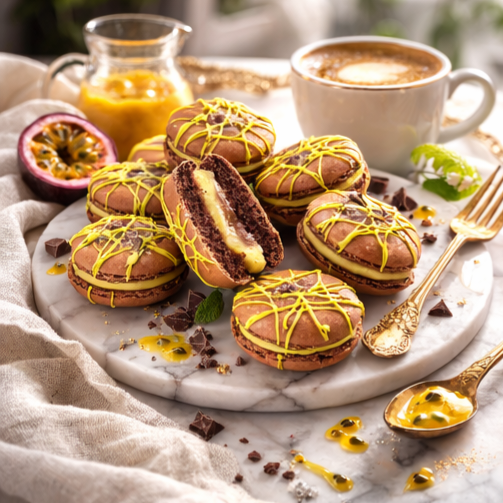
Fit two piping bags with small round tips, such as 10 or 11 by Wilton, and add the passionfruit ganache into one bag and the milk chocolate ganache into the other. Pipe a ring of the passionfruit ganache along the outside edge of the halves of the pre-matched macaron shells; pipe the milk chocolate ganache in the center of the passionfruit ganache ring. Cover with the matching other half of the macaron shell, pressing lightly. Optionally, you may drizzle your filled macarons with heated/runny passionfruit ganache just as shown on these photos.
Refrigerate filled macarons for at least 24 hours so the shells get to “absorb” the filling and develop the flavors. Macarons taste their best after 24 hours of refrigeration, followed by “warming up” to room temperature for at least 30 minutes before consumption.
Frequently Asked Questions
Q. Why did my macarons come out lopsided or without "feet"? This is usually all about the heat! To prevent lopsided shells, make sure to use my doubled baking sheet trick to distribute the heat evenly. Also, don’t skip the 30–40 minute rest before baking—that skin on top is what forces the air to escape through the bottom, creating those beautiful feet!
Q. Can I use fresh egg whites instead of "aging" them? For the most stable, stiff peaks, I highly recommend aging them overnight on the counter. It reduces moisture and strengthens the protein, which is the secret to a successful shell. If you're in a rush, at least ensure they are strictly room temperature before you start whisking!
Q. Why is my ganache too runny for piping? Patience is key! The ganache needs a full 6–8 hours (or overnight) in the fridge to set. If it still feels soft, just whip it with your mixer for exactly 1 minute. It will transform into a light, fluffy, and strong finish that holds its shape perfectly between the shells.
Show your beautiful creations!
There is nothing I love more than seeing what you’re whipping up in your own kitchens. If you make these Chocolate Passionfruit Macarons, please share the magic with me!
Tag me on Instagram @sashacakeschicago and use the hashtag #sashacakeschicago so I can see your stunning bakes and feature them on my stories!

If you loved making this recipe, there’s so much more waiting for you in my book, Baking Magic: Awaken Your Inner Pastry Chef. It’s packed with simple tricks, pro tips, and show-stopping recipes to help you create unforgettable treats with ease.
Grab your copy on Amazon here and awaken your inner pastry chef today! 🍰✨
Disclaimer: Some links in this post are affiliate links, which means I may earn a small commission if you make a purchase—thank you for supporting my baking projects!

Passionfruit Chocolate Macarons
The combination of tart passionfruit and rich chocolate is a total dream, and these Chocolate Passionfruit Macarons are about to become your new obsession! Imagine biting into a perfectly chewy cocoa shell to find a luscious, silky dual-filling. It is a serious show-stopper. Whether you’re prepping for a special celebration or just want to treat yourself to a little kitchen magic, this recipe is guaranteed to impress.
Ingredients
- 125 g egg whites, room temperature
- 125 g granulated sugar
- 6 g egg white powder
- 128 g powdered sugar
- 128 g almond flour (not almond meal)
- 8 g unsweetened cocoa powder
- Brown food coloring gel
- 60 g fresh or frozen seedless passionfruit puree
- 55 g heavy cream
- 10 g unsalted butter
- 125 g high quality white chocolate, chopped
- 40 g high quality milk chocolate
- 170 g heavy cream
- 1 tsp of orange zest
Instructions
- To be done the night before: Separate your egg whites from egg yolks and leave the covered egg whites on the counter overnight to “age.” This is one of the best tricks leading to perfectly whipped stiff peaks that are essential to the success of baked macaron shells.
- Preheat your oven to the standard bake setting at 350°F. Add granulated sugar and egg white powder into a heat-proof container or measuring cup; whisk until combined. Line a baking pan with a sheet of parchment paper and drizzle the sugar mixture over it, spreading evenly. Make sure it’s not too thin—lift the edges of the parchment paper on all sides to even out the sugar mixture edges. Bake on the middle rack for 5 minutes.
- Add the egg whites into a grease-free, clean, dry stand mixer bowl (wipe with a vinegar or lemon juice-soaked paper towel ahead of time). Mix on the lowest speed until egg whites start forming bubbles, gradually increasing the speed to medium-low. Once your egg whites start foaming up, increase the speed to medium and mix until they become frothy, forming soft peaks. By this time, your sugar and egg white powder has warmed up in the oven. Remove it from the oven and transfer it back to your weighing cup or bowl (the easiest way is to lift the parchment paper from opposite ends to form a funnel). Reduce the mixer's speed to the lowest setting and add 1 teaspoon of the warm sugar mixture at a time, pouring it right between the whisk and the bowl while the mixer is continuously whisking. Be careful not to throw the sugar mixture onto the whisk! Once all sugar is added, add a few drops of brown food coloring gel and increase the mixing speed to medium for approximately 3 minutes. Finally, increase the mixer’s speed to the highest setting and whip for 3-5 minutes until stiff peaks are achieved.
- While your meringue is getting to stiff peaks, sift together the powdered sugar, almond flour, and cocoa powder into a separate clean, dry bowl. Discard any large pieces that do not freely pass through the mesh sifter (this should not be more than 1 tsp).
- Once your meringue is ready, remove the bowl from the stand mixer and add the dry ingredients all at once. Fold the dry ingredients into the meringue with a silicone spatula. Once no dry ingredients are visible, start the macaronage: the goal is to remove the air bubbles from the macaron batter without overmixing by pressing and turning the batter against the side of your bowl. Every 3 turns, check for readiness: your batter is ready when it flows slowly from your spatula like a thick ribbon and fully flattens within 30 seconds. Another test is "drawing" a number 8 with the batter; it should flow without breaking. The batter should not be runny—if it is, you have over-mixed.
- Prepare a piping bag fitted with a number 10 or 11 (0.5 cm) piping tip and transfer the batter into the bag. Pipe the batter onto a silicone macaron mat placed onto your second oven tray. (I do not recommend using parchment paper as it does not hold the shape as well or provide flat, unbroken bottoms; however, if you do not have mats yet, parchment paper is okay). Holding your piping bag perpendicular to the mat, slowly pipe a one-inch diameter disc, releasing with a “wiping” motion. Tap your baking tray on the counter a few times; use a toothpick or scriber to pop any air bubbles on the surface. Rest the shells for 30 to 40 minutes until the batter forms a skin, doesn't stick to your finger, and loses some of its shine.
- Meanwhile, preheat your oven to 320°F (any oven needs 10 to 20 minutes to reach the right temperature) along with an additional baking sheet on the middle rack. Baking on doubled baking sheets prevents uneven or lopsided macarons! Place the baking pan with the silicone mat onto the preheated separate baking sheet on the middle rack. Bake for 20-25 minutes, turning the tray around halfway through after the first 15 minutes. Macarons are fully baked when they do not feel wiggly or flimsy if lightly touched. Allow them to fully cool before removing them from the mats.
- Pro-tip: If your oven is quite hot/strong and your macarons typically “brown” during baking, place a piece of domed aluminum foil over them after 10-15 minutes of baking. You may also try this setting: preheat to 350°F, place the piped shells inside and immediately reduce the heat to 300°F. Bake for 25-27 minutes, covering with foil halfway through.
- Bring the passionfruit puree to a boil. Separately heat the heavy cream in the microwave or on the stove.
- Pour both liquids over the white chocolate. Mix well with a silicone spatula until all ingredients have combined to a uniform, smooth finish.
- Add the cubed butter. Mix well with your silicone spatula until combined.
- Cover with plastic wrap/cling contact. The plastic wrap must be touching and fully covering the surface of the ganache. Refrigerate for 6–8 hours.
- Whip the cold ganache with a hand or stand mixer for just 1 minute to a light, fluffy, strong finish.
- Heat the heavy cream to just about a boil point and pour it over the chocolate. Mix well with the silicone spatula until the heavy cream and the chocolate combine together to a uniform, smooth mixture.
- Fold in the orange zest with the silicone spatula.
- Cover with the kitchen plastic/cling film, with it fully touching the surface of the ganache to prevent any condensation. Place into the refrigerator for at least 8 hours.
- Once the ganache sets in the refrigerator, whip it again with a hand mixer or immersion blender for just about 1 minute. Make sure not to overmix!
- Fit two piping bags with small round tips, such as 10 or 11 by Wilton, and add the passionfruit ganache into one bag and the milk chocolate ganache into the other. Pipe a ring of the passionfruit ganache along the outside edge of the halves of the pre-matched macaron shells; pipe the milk chocolate ganache in the center of the passionfruit ganache ring. Cover with the matching other half of the macaron shell, pressing lightly. Optionally, you may drizzle your filled macarons with heated/runny passionfruit ganache just as shown on these photos.
- Refrigerate filled macarons for at least 24 hours so the shells get to “absorb” the filling and develop the flavors. Macarons taste their best after 24 hours of refrigeration, followed by “warming up” to room temperature for at least 30 minutes before consumption.